

Home/About us

How to use this site

Basic principles

  I want to remove..

On Line Shop

Products

  Contact us

Checkout/Basket

Legal pages


STRIPPER 4-F GRAFFITI STRIPPER G-102
NEUTRALISER N-20 KLING-STRIP
STRIPPER NB-510 STRIPPER NB-410
VACWASH STRIPPER NB-610
WOODBLEACH WB-1


Click on the icons above to download the Usage Data Sheets


USAGE DATA SHEET

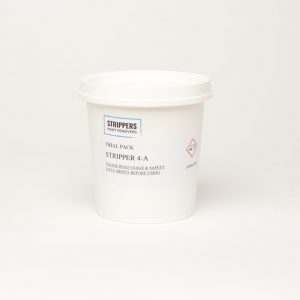
PRODUCT: STRIPPER 4-F

TYPE: Alkali-based paint remover.

USES: For removing thick layers of oil-based paints from brickwork. May also be suitable for other types of coating.

METHOD OF USE:
Preparation:
The surface should first be washed down with a pressure washer to remove any loose or flaking paint, or heavy deposits of dirt, and wet any exposed or thinly-painted areas of the substrate, which should never be completely dry when applying the product. Carry out a test on a small area first. See also "COMPATIBILITY" below.

Application: By brush, spreader or suitable airless spray equipment. Only use brushes with plastic bristles – a soft-bristled dustpan brush is good for the purpose. The product must be applied generously to the surface - as thickly as possible, so that it begins to run over itself - and then left to dissolve the paint. (Please ask for details of specification for airless sprayers.)

Leaving the product to work: It is most important to allow Stripper 4-F sufficient time to dissolve the paint. It is a slow-acting product but one application can dissolve a very thick paint layer if given enough time to do so. It is normally left for up to 48 hours but the temperature will affect the time required in each particular case. Thin paint layers will only need 2 or 3 hours; many paint layers can be dissolved overnight. For very thick paint, leave for 2 days or longer. Once the paint has been dissolved by Stripper 4-F, it will not harden again, so can be left indefinitely before being removed. Very thick paint layers, particularly in the crevices of a detailed surface, will need further application(s). The product will not work in temperatures near freezing.

Removal: Wash off the dissolved paint with a pressure washer. Cold water is usually adequate but a hot water machine is often quicker and more effective. If necessary, the bulk of the dissolved paint may be removed with a scraper before washing off. When washing off, commence from the bottom of each area and work upwards, then rinse from the top downwards. Ensure that any unpainted surface below is wetted first.

COVERAGE: 1.5 to 3 litres per square metre.

COMPATIBILITY: The product is compatible with brickwork and most masonry surfaces, but a test should always be carried out on a small area first to determine any unacceptable reaction. The product can damage aluminium and stained glass. Plastics are not affected. Details of compatibility of any specific material are available on request.

REPAINTING: If the surface is to be repainted, it should be washed down very thoroughly and then be allowed to dry out completely. If any efflorescence then occurs, it must be brushed off the surface, which should then be neutralised by spraying or brushing on and allowed to dry thoroughly afterwards. No painting should be done until it is certain that the surface is completely dry and that efflorescence will not re-occur. This may require waiting for a period of dry-weather. Use an alkali-resistant primer.

N.B. Impervious exterior paint coatings are a common cause of what is often alarmingly rapid decay of exterior building surfaces, also of damp problems internally. If it is essential to repaint, consider using limewash or lime paint, which are highly vapour permeable. (We can supply both).

STORAGE: The product is non-flammable and will not support combustion. Do not expose to frost.

CAUTION: Suitable protective clothing must be worn when handling or using the product.


Return to top


USAGE DATA SHEET

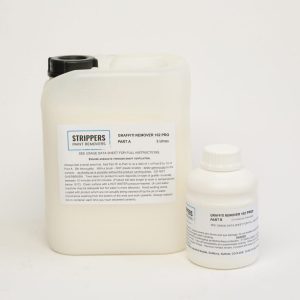
PRODUCT: GRAFFITI STRIPPER G-102

TYPE: Solvent-based graffiti remover, for use on otherwise unpainted surfaces.

USES: Highly effective for removing graffiti in most types of aerosol and other paints, and certain varieties of felt-tip ink, from otherwise unpainted brick, stone or concrete, without marking or damage to the surface.

METHOD OF USE:
Preparation:
The product is supplied in two parts and must be mixed thoroughly just before use. Add part ‘B’ (the Activator) to Part ‘A’. (If a smaller amount of mixture is required, the mix ratio is 10 parts by volume of Part ‘A’ to one of Part ‘B’). N.B. The product, once mixed, should be used within 24 hours. The surface of the coating to be removed must be dry. The product will take longer to work in ambient temperatures below 10°c.

Application: Apply by brush or suitable airless spray equipment. Do not use brushes with plastic bristles. (Please ask for details of specification for airless sprayers.) The product must be applied generously. Make sure crevices in porous surfaces are well filled with the product and do not brush out too thinly, as this will cause the volatile ingredients in the product to evaporate before they can dissolve the graffiti.

Removal: Once the graffiti is dissolved - which will take anything between 2 minutes and one hour - the surface is cleaned using a hot-water pressure-washer. A cold-water machine may be adequate, but hot water is much more effective. IMPORTANT: Avoid wetting the areas coated with the product until they are actually being cleaned by the jet of water. Always commence washing from the bottom of the area and work upwards.

N.B. Our WASHVAC pressure- washer/vacuum cleaner attachment makes it possible to use a pressure washer in areas where the spray and runoff from a normal pressure-washer lance would be unacceptable.

COVERAGE:  Approximately 1 litre per sq.metre

COMPATIBILITY: The product is compatible with most masonry and timber surfaces, although some types of render may be affected. Some plastics are damaged by the product. To be sure, always test a small area first. Polythene is compatible, making it a suitable material for masking, etc.

STORAGE: Must not be exposed to frost or stored at temperatures in excess of 30°c. Do not leave containers in direct sunlight.

CAUTION: Suitable protective clothing must be worn when handling or using the product.


Return to top


USAGE DATA SHEET

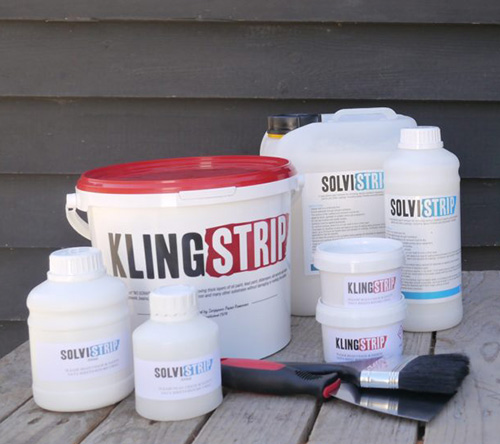
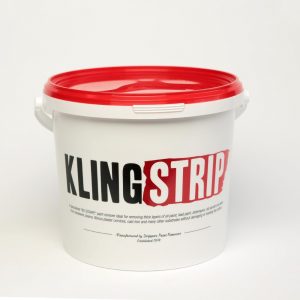
PRODUCT: KLING-STRIP

TYPE: Poultice-type alkali-based paint-remover

APPLICATIONS: For removing thick layers of oil-based paints, distempers etc, old varnishes and stains, from timber, render, stone, marble, brick, fibrous plaster, cast-iron and many other substrates. Being a wet process, it also provides a safer means of removing paint containing lead.

PRINCIPLES OF THE PRODUCT: Kling-Strip is a thixotropic paste which, when applied thickly to the surface, will gradually dissolve the paint to a water soluble residue which is then simply washed off.  Its poultice action draws out paint and stain from the pores of the surface or the grain of the wood, which are then left completely free of paint by the washing.  Because no scraping is necessary it is thus possible to completely remove paint even from ornate work without any damage.

METHOD OF USE:

[A] CARRY OUT A TEST ON A SMALL AREA FIRST.  A test will ensure that Kling-Strip is the correct paint-remover for the job (see also "COMPATIBILITY " below), help you to work out how much you need, how thickly it needs to be applied and how long you need to leave it to work:

  • Apply a 3"- 4" square (75-100mm) patch of Kling-Strip.
  • Apply the product at least 3/8” (10mm) thick on one side of the patch and taper the thickness off to nothing on the other side. This will give you an indication of how thickly you will need to apply it when you come to do the actual job.
  • Stick some thin polythene (clingfilm, plastic bag, bin liner etc.) to the patch and leave to work, then follow on from [C] below.

N.B. To calculate the quantity required: each mm of thickness of Kling-Strip= 1 litre per sq.m.
e.g. If tests show that Kling-Strip needs to be applied 5mm thick, 5 x 1 litre = 5 litres per.sq.m

[B] APPLYING KLING-STRIP:
Using a small trowel, flat-blade scraper, or any suitable spreading tool, apply Kling-Strip 3mm to 6mm thick - even thicker on very thick paint layers. The thicker the paint layer the longer Kling-Strip needs to work and the thicker it must therefore be applied. If applied too thinly, it will simply dry out before it has time to work.

Stick some thin polythene (clingfilm, plasticbag, bin liner etc.) to the applied Kling-Strip to keep it moist. For bannisters, glazing bars etc. apply the Kling-Strip directly to the polythene; the coated polythene can then be picked up and applied to the bannister, making application very quick and easy.

[C] LEAVING THE KLING-STRIP TO WORK:
It is important to allow Kling-Strip sufficient time to dissolve the paint. Anything from 15 minutes to several days. The thicker the paint layer, the longer it will take. One application can dissolve a very thick paint layer if given enough time to do so. Thin paint layers will only need 2 or 3 hours; many paint layers can be dissolved overnight. For very thick paint, leave for 2 days or longer. For plaster cornices etc., leave for at least 5 days. Very thick paint layers, particularly in the crevices of a detailed surface, will need further application(s).

Kling-Strip will not work in temperatures near freezing and will dry out too quickly in direct sunlight or at high ambient temperatures.

[D] REMOVING KLING-STRIP AND WASHING OFF THE DISSOLVED PAINT:
Remove the bulk of the Kling-Strip and dissolved paint, taking care not to scratch or damage the surface. The residue is then simply washed from the surface with a scrubbing brush, sponge and water, or a pressure-washer if the situation allows. A pump-up garden spray is also useful if washing down by hand.
When doing tests, do always wash off the residues even though the paint-remover may appear not to have worked. This often produces unexpected results.
For plaster cornices etc., having removed the bulk of the Kling-Strip, allow the residue to dry - which will cause it to shrink slightly - then brush off and carefully pick out, before gently washing to finish off.

N.B. Our WASHVAC pressure-washer/vacuum cleaner attachment makes it possible to use a pressure-washer in areas where the spray and runoff from a normal pressure-washer lance would be unacceptable.

COVERAGE: 3 to 6 litres per square metre, depending on the thickness of paint, profile of surface etc.
N.B. To calculate the quantity required: each mm of thickness of Kling-Strip= 1 litre per sq.m.
e.g. If tests show that Kling-Strip needs to be applied 5mm thick, 5 x 1 litre = 5 litres per.sq.m

COMPATABILITY:
A test must always be carried out to ensure that there is no adverse reaction with the substrate or adjacent materials. Do not use on veneers. May soften gesso and similar oil-bound plaster decoration. May darken some wood surfaces, particularly teak and mahogany.  May leave a “water mark” on timber surfaces if not applied to whole area.  Avoid contact with aluminium. Details of compatibility of any specific material are available on request.
N.B. our A & B WOODBLEACH is very effective for lightening the colour of most timbers.

REPAINTING:
If the surface is to be repainted, it should be washed down very thoroughly and then allowed to dry out completely. If any efflorescence then occurs, this must be brushed off and the surface thoroughly rinsed again.  Timber and brick surfaces may be neutralised by sponging with NEUTRALISER N-20 (see price list) or a solution of vinegar and allowed to dry thoroughly afterwards. No painting should be done until it is certain that the surface is completely dry and that efflorescence will not re-occur. Use an alkali-resistant primer.

STORAGE: